SQL Tech Interview Questions (Essential Q&A Australia 2026)

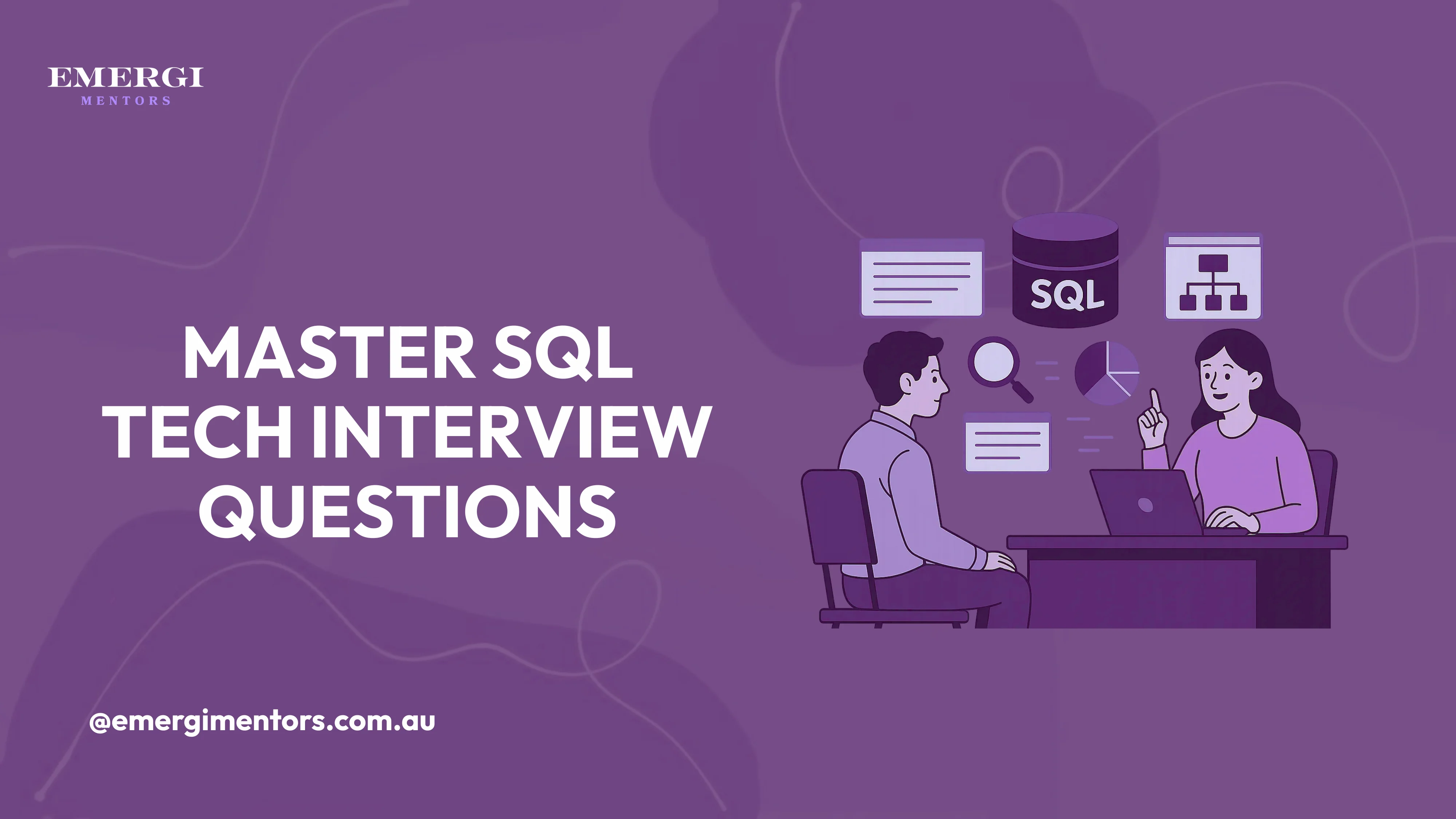
Preparing for SQL tech interview questions can make or break your chances of landing a developer role in Australia's competitive tech market. They remain essential for job hunters, hiring managers, and recruiters, covering both general topics and technical scenarios. Whether you're interviewing for positions in Sydney's fintech companies or Melbourne's startup scene, mastering SQL interview questions is crucial for demonstrating your database competency and problem-solving skills.
Connect with SQL experts who've successfully navigated tech interviews at leading Australian companies. Start your journey today at Emergi Mentors and transform your interview performance.
Why SQL Tech Interview Questions Matter More Than Ever
SQL remains the backbone of data management across Australian tech companies. From banking applications processing millions of transactions to e-commerce platforms managing customer data, SQL skills determine how effectively you can work with databases. Interviewers use SQL tech interview questions to assess your logical thinking, understanding of database relationships, and ability to write efficient queries under pressure.
Here are some of the best databases for Data Analytics in Australia
Modern Australian tech companies expect developers to handle complex data scenarios. Your performance on the SQL tech interview directly reflects your capability to work with real-world database challenges, optimize performance, and maintain data integrity.
Essential SQL Tech Interview Questions by Category
Fundamental SQL Tech Interview Questions
1. What is the difference between INNER JOIN and LEFT JOIN? INNER JOIN returns only matching records from both tables, while LEFT JOIN returns all records from the left table plus matching records from the right table. This question is among the most common SQL interview questions because joins form the foundation of relational database operations.
2. Explain the difference between WHERE and HAVING clauses. WHERE filters rows before grouping, while HAVING filters groups after aggregation. Interviewers ask this to test your understanding of query execution order.
3. What is a primary key versus a foreign key? A primary key uniquely identifies each row in a table, while a foreign key creates relationships between tables. This fundamental concept appears in most SQL tech interview questions.
Intermediate SQL Tech Interview Questions
4. How do you find duplicate records in a table?
sql
SELECT column_name, COUNT(*)
FROM table_name
GROUP BY column_name
HAVING COUNT(*) > 1;
5. What is the difference between UNION and UNION ALL? UNION removes duplicates and sorts results, while UNION ALL includes all records without removing duplicates. Performance-focused interview questions often explore this distinction.
6. Explain correlated vs. nested subqueries. A correlated subquery references data from the outer query in its WHERE clause, while a nested subquery can be placed anywhere in the outer query and doesn't directly reference the outer table.
Advanced SQL Tech Interview Questions
7. How would you optimize a slow-running query? Consider indexing, query structure, join order, and avoiding SELECT *. Australian tech companies value developers who understand performance optimization.
8. What is database normalization? It is the process of organizing data to reduce redundancy and improve data integrity through normal forms (1NF, 2NF, 3NF, BCNF).
9. Explain ACID properties. Atomicity, consistency, isolation, and durability ensure reliable database transactions; critical knowledge for enterprise applications.
Common SQL Query Patterns in Tech Interviews
Australian companies frequently test your ability to write queries for business scenarios. Practice these patterns:
Finding top N records per group
Calculating running totals and moving averages
Working with date ranges and time-based data
Handling NULL values appropriately
Writing recursive queries for hierarchical data
SQL tech interview questions often involve real business problems like analyzing sales data, managing user accounts, or processing transaction histories.
Advanced Topics for Senior Roles
For senior positions, SQL interview questions become more sophisticated:
Database Security: SQL injection prevention through parameterized queries and stored procedures remains crucial for application security.
Performance Tuning: Understanding execution plans, index strategies, and query optimization techniques.
Data Warehousing: Knowledge of ETL processes, dimensional modeling, and analytical queries.
Preparation Strategies for Success
Practice with Real Data: Use sample databases like Northwind or create your own datasets reflecting Australian business scenarios.
Understand Query Execution: Learn how databases process queries internally to answer optimization questions confidently.
Review Company-Specific Requirements: Research the specific database systems (PostgreSQL, MySQL, SQL Server) used by your target companies.
Mock Interview Practice: Work through SQL tech interview questions under time pressure to build confidence.
Common Mistakes to Avoid
Don't memorize answers without understanding concepts. Interviewers can quickly identify surface-level knowledge. Instead, focus on explaining your thought process and demonstrating problem-solving approaches.
Avoid writing overly complex queries when simpler solutions exist. Australian tech companies value clean, maintainable code over clever but unreadable solutions.
Boost Your Interview Success
Mastering SQL tech interview questions requires consistent practice and expert guidance. While technical knowledge is essential, understanding how to communicate your solutions effectively often determines interview success.
Want to ace your next SQL interview with confidence?
Get personalized interview coaching by signing up to Emergi Mentors and work with experienced mentors who understand the Australian tech market.