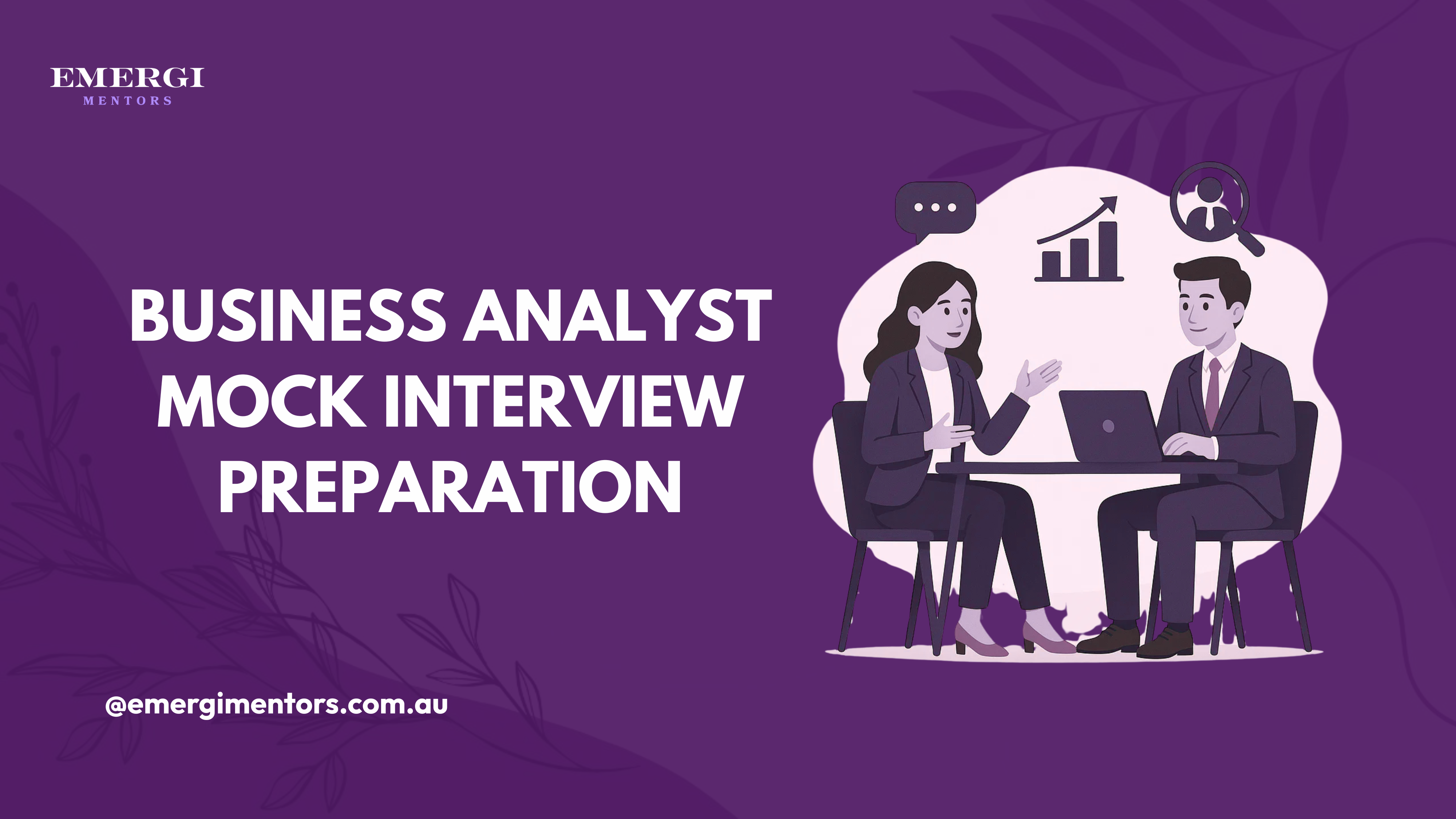
Business Analyst Interview Preparation: Get Your Dream Job 2026

Have you also spent days preparing for a business analyst interview while memorising definitions? People memorise what a BRD is. They rehearse what Agile means. They google ‘business analyst interview questions’ at 11pm the night before and copy answers into a notes app. Then they walk into the interview and get nervous, not because they didn't know the material, but because they hadn't practiced giving answers in te moment, framing their experience compellingly, or connecting their past work to what Australian hiring managers care about in 2026.
We’ll teach you in this article what a real BA interview prep looks like. What questions you'll be asked, the frameworks that get under pressure, and what separates candidates who get offers from those who get polite rejections.
What Australian Employers Want in a BA Interview
Australian business market is competitive and it’s getting more fierce day by day. ICT Business Analyst (ANZSCO 261111) is appearing on skills shortage lists consistently. The Australian tech sector is projected to keep growing through 2030, and hiring managers aren't just filling seats. They're looking for someone who can step in and add value fast.
The assessment usually breaks down into three things in interviews at major employers such as banks, consultancies, government agencies, and tech firms. The ability to analyse a messy business problem and structure your thinking clearly. Whether you can work with stakeholders who don't share your vocabulary or if you've done this before or can show you're capable of it.
Your answers need to fit all three even if you're applying for your first BA role.
Common Business Analyst Interview Questions
There's not a single list that covers every interview, but these categories are seen consistently across Australian BA interviews from entry-level positions to senior analyst roles.

Core Business Analysis Questions
What is your process for gathering requirements from stakeholders?
How do you handle conflicting priorities when managing multiple stakeholders?
Walk me through how you'd document requirements for a new system.
What's the difference between functional and non-functional requirements?
These sound basic, but your answer reveals whether you think in a structured way or whether you can adapt to context. Recruiters are listening to structure, not just definitions.
Behavioural Questions like “Tell me about a time you had to communicate complex findings to a non-technical audience, describe a situation where stakeholder requirements kept changing. How did you manage it? And give an example of a project where things didn't go according to plan. What did you do?
This stage is where most candidates underperform not because they lack experience, but because they haven't practiced framing it. The STAR method (Situation, Task, Action, Result) is your structural anchor here. Don't just tell the story, describe the outcome with a measurable impact wherever possible.
Technical and Tool-Based Questions
In 2026, many interviewers are also asking about AI tools; What tools have you used for process mapping or requirements documentation? How familiar are you with Agile or Scrum environments? And have you worked with SQL or data visualisation tools like Power BI or Tableau? These are common technical and tool-based questions.
How do you use AI tools to draft user stories, map processes, or research faster. If you've worked with any AI-assisted BA workflows, mention them. It shows you're keeping up with how the role is evolving.
How to Actually Do Business Analyst Interview Preparation
There's a gap between preparation and readiness. Just reading lists of interview questions is preparation but knowing how to answer them under pressure is readiness, and most candidates don't close this gap before their interview.
1. Evaluate Your Experience Using the STAR Framework
Start by writing down five to eight situations from your work history or study projects, internships, or volunteer work, that show problem-solving, stakeholder communication, or process improvement. For each one, set the Situation, Task, Action, and Result. Don't memorise the scripts. Remeber the shape of the story.
2. Research the Company's Industry Context
If you got A Business analyst interview at a healthcare company, it would look different to the one you had at a fintech startup. Understand the sector, the typical pain points a BA in that space would face, and any recent developments in their business. Referring to something specific about the organisation in your answers is a reliable way to stand out.
3. Prepare Two or Three Strong Process Stories
Can you break down a problem? or work with people who disagree, and deliver something useful? Almost every BA interview has these types of questions. If you have two or three concrete examples that answer those hinted questions, you'll be able to adapt them to almost any question they throw at you.
4. Practice Out Loud
Reading through answers doesn't wire your brain the same way speaking them does. So, record yourself answering common questions. Notice yourself where you use filler words, where your answers run too long, and where the impact of your example gets meaningless. Keep adjusting until your delivery is clear and confident.
Working through BA interview prep alone is slow, and it's hard to know what you can't see about your own answers. Emergi Mentors connects you with experienced BA professionals across Australia who can run mock interviews, give honest feedback on your STAR stories, and tell you what hiring managers in your target industry are looking for.
What's Changing in BA Interviews in 2026
Business Analysts who can work faster and smarter using AI tools, whether that's drafting documents, summarising stakeholder feedback, or mapping workflows are more attractive to employers as a result AI literacy is increasingly part of the job description. Even basic working knowledge of AI puts you ahead of candidates who haven't engaged with this at all.
Now, scenario-based questions are replacing simple definition questions at most mid-to-senior level interviews. These are harder to get through and easier to answer well if you've prepared structured examples.
Remote and hybrid work has also changed what stakeholder management looks like. Say if you've navigated requirements gathering across distributed teams as it's a real differentiator in post-pandemic hiring.
You can do everything right like researching the company, memorise frameworks, prepare your STAR examples, and still walk out of the room feeling like the interviewer never really saw what you can do.
The kind of insight a good mentor brings to interview preparation is knowing what a hiring manager at a big four bank and what a startup technical lead cares about.
Our mentors give encouragement, and specific, honest feedback grounded in how Australian tech hiring works.
Frequently Asked Questions
What are the most common business analyst interview questions in Australia?
The most asked questions cover requirements gathering, stakeholder management, process analysis, and behavioral scenarios using the STAR method.
How do I prepare for a business analyst interview with no prior BA experience?
Focus on transferrable skills, analytical thinking, stakeholder communication, and process documentation from whatever roles you've had.
What is the STAR method and how does it apply to BA interviews?
It's a structured way to answer behavioural interview questions by grounding your answer in a specific experience. for example, a process improvement that reduced reporting time by 40%, or a stakeholder conflict that you resolved and led to on-time delivery.
What technical skills are important for a business analyst interview?
Requirement documentation, process mapping tools (such as Visio or Lucidchart), SQL for data querying, and data visualisation platforms like Power BI or Tableau are important.
What is the average salary of business analyst in Australia in 2026?
Entry-level BA roles in Australia typically start around AUD 80,000 to 98,000. Mid-level roles are between AUD 100,000 to120,000, with senior Business Analysts and specialists in finance or technology earning average AUD 130,000 to160,000 or more.
If you're heading into the BA job market in Australia whether you're transitioning from another field, finishing a degree, or looking to move up the difference between a good interview and a great one usually comes down to preparation quality.