What Should I Learn First, SQL or Python? Expert Advice

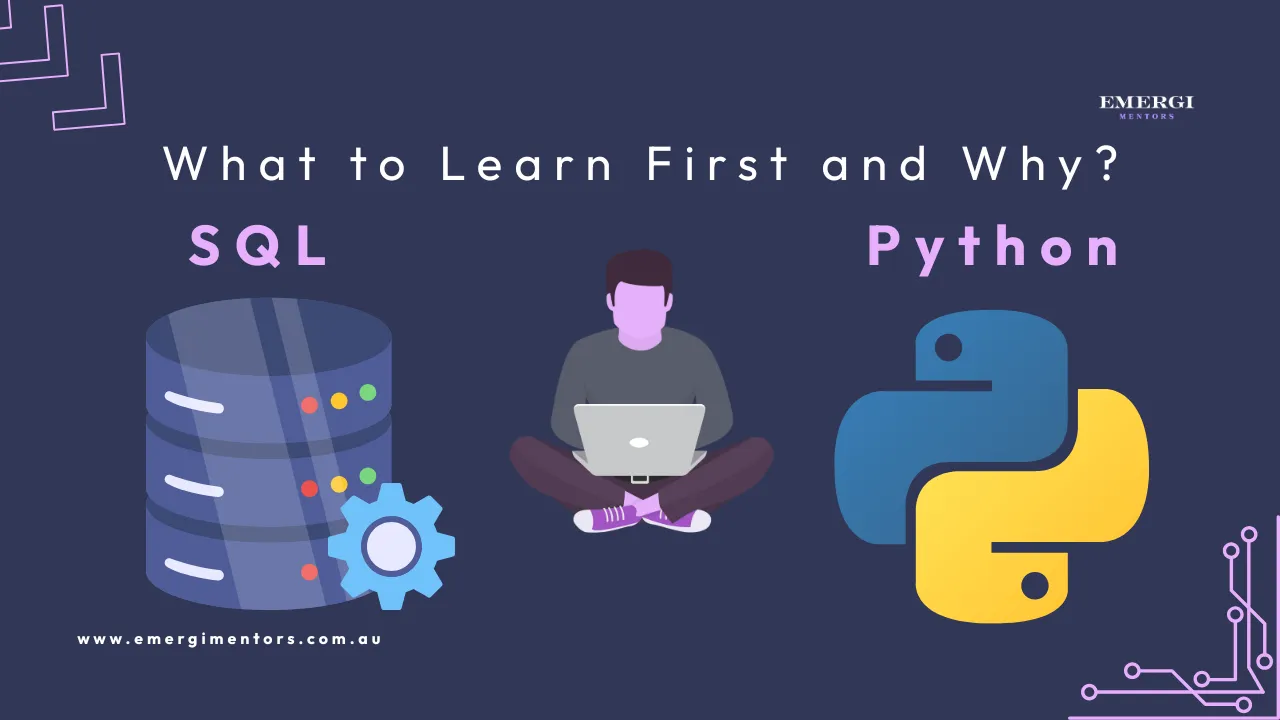
You have been staring at your computer screen and finally decided to dive into programming. Congratulations! But now you're facing the first of many technical crossroads: should you learn SQL or Python first? This common problem stops many aspiring tech professionals before they even begin their journey.
With thousands of online courses, bootcamps, and tutorials available for both languages, making the right choice for your specific situation can highly impact your learning momentum and future career. As experienced mentors who've guided hundreds through this exact decision, we'll help you navigate this important first step.

Understanding SQL or Python: Core Differences
Before deciding which to learn first, let's clarify what each language is designed to do:
SQL: The Language of Data
SQL (Structured Query Language) is designed for manipulating and managing the data in relational databases. According to the 2023 Stack Overflow Developer Survey, SQL remains the third most commonly used programming language, with 49.7% of developers reporting they use it regularly.
Strengths of SQL:
Relatively straightforward syntax focused on data operations
Immediate practical application in nearly any business context
Highly specialized for database interactions
Typically shorter learning curve to basic expertise
Essential for data analysis and business intelligence jobs
Common SQL Uses:
Retrieving specific information from databases
Analyzing large datasets
Generating business reports
Managing and organizing structured data
Supporting data-driven decision making
Python: The Versatile Powerhouse
Python is a general programming language known for being readable and versatile. It consistently ranks as the most wanted language among developers who aren't currently using it, with 17.6% hoping to adopt it in the future.
Strengths of Python:
Exceptionally readable syntax designed for beginners
Extreme versatility across multiple domains
Extensive libraries and frameworks for specialized tasks
Strong community support and abundant learning resources
Foundation for advanced fields like machine learning and data science
Common Python Uses:
Web development (with frameworks like Django and Flask)
Data analysis and visualization
Automation and scripting
Machine learning and AI applications
Software development and testing
Career Path Considerations: Which Comes First?
Your prime starting point depends largely on your career expectations:
For Data-Focused Careers
If you're targeting roles in data analysis, business intelligence, or database administration:
Start with SQL if:
You need to demonstrate immediate value in a business context
Your primary goal involves analyzing existing data
You're transitioning from a non-technical business role
You want faster initial progress toward job-ready skills
Start with Python if:
You aim to perform advanced statistical analysis
Your goals include data visualization and presentation
You eventually want to move into machine learning
You prefer building automated data pipelines
According to the 2024 Data Professional Survey by Burtch Works, 78% of data analysts use SQL daily, while 64% regularly use Python. Both are ultimately essential, but SQL often provides more immediate practical application in entry-level data roles.
For Software Development Careers
If you're aiming for software engineering or development roles:
Start with Python if:
You have no prior programming experience
You want a gentle introduction to programming concepts
Your goal is to become a great developer
You're interested in building complete applications
Add SQL when:
You need to store and retrieve data in your applications
You're ready to build more complex, data-driven projects
You want to understand database design principles
You're preparing for full-stack development roles
The Bureau of Labor Statistics projects software developer jobs to grow 25% by 2030, with full-stack skills (including both programming and database knowledge) commanding premium salaries.
Learning Style Compatibility
Beyond career goals, consider how each language aligns with your learning preferences:
SQL Might Be Better First If You:
Prefer concrete, practical skills with immediate application
Enjoy logical, structured thinking with clear rules
Want to see results quickly to maintain motivation
Have a background in mathematics or analytical thinking
Learn best through solving specific, defined problems
Python Might Be Better First If You:
Enjoy creative problem-solving and building things from scratch
Prefer a gradual introduction to programming concepts
Want to understand fundamental computer science principles
Have patience for a slightly steeper initial learning curve
Learn best through diverse, project-based applications
Strategic Learning Approach: The Complementary Path
While choosing a starting point is important, remember that SQL and Python are complementary skills that work powerfully together. A strategic approach often includes
Learn basic concepts in your primary choice (2-4 weeks)
Build simple projects applying these fundamentals (3-6 weeks)
Introduce fundamentals of the second language (2-4 weeks)
Create integrated projects using both skills (ongoing)
This layered approach typically yields faster progress than attempting to master one language completely before starting the other.
How Mentorship Accelerates Either Path
The difference between struggling for months and making rapid progress often comes down to personalized guidance. A mentor who understands both languages can assess your specific background to recommend the optimal starting point. He can identify knowledge gaps that might not be covered in your standard courses. A mentor provides context for real-world applications beyond theoretical examples and also guides your project selection to build relevant portfolio pieces. A mentor can troubleshoot obstacles on your behalf when you inevitably encounter them.
Industry research shows that mentored learners are 66% more likely to complete technical courses and report 70% higher confidence in their skills compared to self-directed learners.

Emergi Mentors: Your Technology Learning Partner
At Emergi Mentors, our platform connects aspiring tech professionals with experienced mentors who have mastered both SQL and Python in real-world environments. Rather than following generic online courses designed for everyone, our mentors create personalized learning paths based on your specific career goals and timeline. They keep all factors like your existing technical knowledge, transferable skills, learning style, and available commitments in mind and help you accordingly. They often know the current industry demands in your target location.
Our mentors include data scientists, software engineers, and analytics professionals who use these languages daily and understand exactly what employers are looking for in professionals while selecting a perfect candidate.
Take the Next Step in Your Tech Journey
Stop wondering which path to take and start making concrete progress with expert guidance. Book a session with an Emergi Mentors programming specialist today to get these benefits:
Assess your current skills and career objectives
Develop a customized learning roadmap for SQL, Python, or both
Get recommendations for resources that match your learning style
Create accountability structures to ensure consistent progress
Book Your Programming Path Mentor Session Now. Your journey from confusion to clarity starts with a conversation.