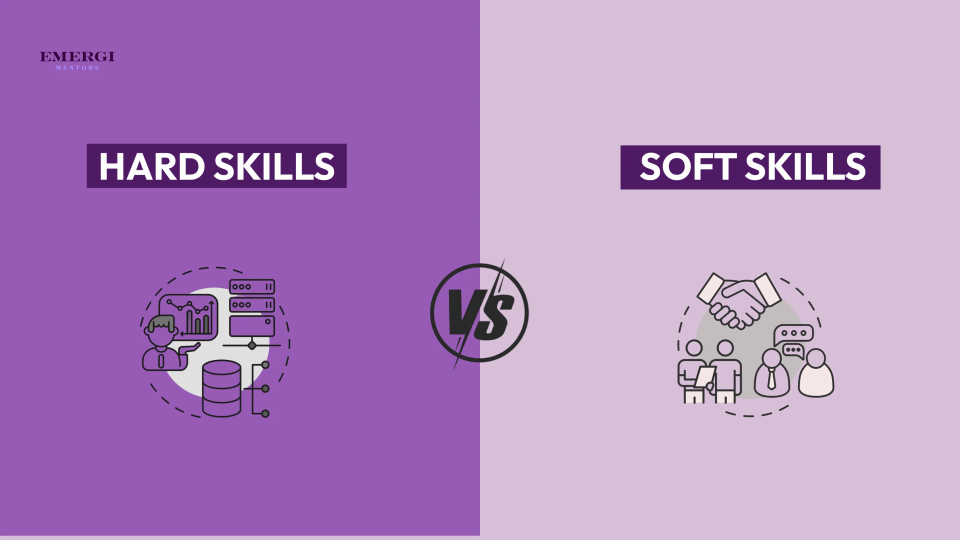
Hard Skills vs Soft Skills: What Actually Gets You Hired?

You've polished your resume, highlighted your certifications, and listed every technical skill you've mastered. But do you know it? 90% of hiring managers, according to the LinkedIn Global Talent Trend report, now believe soft skills are equally important to land a job. Also, 89% of bad hires lack basic soft skills. If you are still relying only on just your technical abilities, you could be left behind by many candidates who have both. Our career mentors work with professionals across industries and have seen firsthand how misunderstanding this balance can lead to frustration and missed opportunities.
If you're wondering whether to improve your Python skills or work on your emotional intelligence, or if you’re a hiring manager stuck between a technically brilliant candidate who is not a team player and an average-skilled candidate with strong people skills, you’re asking the right question: Hard Skills vs Soft Skills: What Actually Gets You Hired?
Understanding the Difference Between Hard Skills and Soft Skills
Let's get specific. Hard skills are your technical abilities. They are measurable, teachable abilities that you can prove on paper. Perhaps data analysis, proficiency in AutoCAD, financial modeling, or fluency in Mandarin. These are the skills that get your resume past the ATS scanners and into human hands. They're what makes you qualified on paper.
If you ask about soft skills, they are not very visible on paper but are equally important. We're talking about communication, adaptability, problem-solving, emotional intelligence, and teamwork. These still are necessary to make your work efficient when hired for the job. In 2026, 60% of employers value soft skills which were not considered valuable 5 years ago. Most of the time professionals don’t perform well when hiring managers choose them based on their strong technical skills even if they lack soft skills.
Why Soft Skills Are Gaining Importance Now
Since AI and automation now manage many routine tasks, employees need to focus more on productivity and adapting to change. The skills humans demonstrate, such as creativity, empathy, and strategic thinking, are becoming your market advantage. Communication is the most important skill now, and adaptability has also seen the biggest year-over-year growth in 2024.
The workplace has changed, too. Remote and hybrid work arrangements need people to build relations via screens and communicate across different time zones. You need to work on multi-functional projects which require you to collaborate with people who think differently than you. And with technology evolving rapidly, your ability to learn and adapt to changes matters more than any specific tool you know today.
A software engineer may know six programming languages, but if they can't explain their code to non-technical stakeholders or work collaboratively with designers and product managers, their contribution is limited. One of our marketing managers had multiple certifications for every platform, but he was unable to read the room. He couldn’t negotiate with vendors or inspire the team; in the end he struggled to lead the team effectively.
Hard Skills vs. Soft Skills on Resume
When creating their resume and optimising their LinkedIn profile, smart candidates show hard skills with proof and soft skills through results. When you list your hard skills, be specific like this: advanced proficiency in Tableau for data visualization, certified project management professional (PMP), native Spanish speaker with business-level French, and for soft skills, proving them through outcomes is the right way.
Instead of saying "excellent communicator", write "Led cross-functional team of 12 through major product launch, improving stakeholder alignment by presenting weekly updates tailored to technical and executive audiences." If you want to accelerate your career development and learn leadership skills from industry experts, now is the right time to get in touch.
Hard Skills vs. Soft Skills in the Workplace
Different roles and industries value hard skills and soft skills differently
When Hard Skills Are Important | When Soft Skills Are Important |
Highly technical roles like data scientists, engineers, healthcare professionals, etc. | Leadership and management positions |
Entry-level positions where you need to prove basic abilities | Roles in sales, consulting, or customer success, or where you need to face clients |
Regulatory industries requiring specific certifications | Teamwork and collaborative environment |
Roles with clear, measurable technical outputs | Industries undergoing rapid change |
But both skills are mandatory in technical roles. Organisations that invest in both hard and soft skills development see 2 times higher employee productivity and retention rates than those companies which are only focusing on one specific area.
In Australia’s job market, whether you are trying to land a job in Sydney’s tech sector, Melbourne’s growing finance industry, or Brisbane’s startup culture, only relying on your technical abilities and ignoring soft skills will make your job search difficult. Often companies shortlist candidates with prominent tech skills, but at the end the person with the best social skills is selected.
Importance of Soft Skills Globally
Apart from Australia, the US and the UK, 85% of hiring decision-makers use skills-based hiring methods, and soft skills tests are the most popular test type in 2025. Employers are getting more knowledgeable about assessing both aspects. They're asking behavioral questions: "Tell me about a time you had to direct someone without authority" or "Describe how you've handled a major setback."
Employers are also paying close attention to how you communicate during the interview, not just what you say, but also how you listen, ask questions, and change your communication style.
Hard Skills vs Soft Skills: Understand the Balance
When candidates don’t have advanced technical abilities in any organisation where new technologies are being adopted, the organisation fails to operate properly. When someone lacks tech skills for a role, the problems are obvious and immediate. But when someone lacks soft skills, the loss is hidden. At times team morale drops and projects begin to fail due to poor communication. Talented people leave because they can't work with difficult colleagues. Innovation decreases when people can't collaborate effectively or adapt to new approaches.
A person might get the job based on technical expertise alone, but you'll struggle to advance without strong interpersonal skills. For job seekers, soft skills are equally important along with tech skills as employees who develop strong soft skills progress fast in their careers. They get noticed by their colleagues and seniors and earn their favor with good communication skills and friendliness.
How to Develop Both Sets of Skills Strategically
You can always learn both hard skills and technical skills, with proper guidance, exposure to real-world scenarios, and other sources.
Building Hard Skills | Developing soft skills |
Taking technical courses on platforms like Coursera, LinkedIn Learning, or industry-specific training | Ask for honest feedback from colleagues, managers, and mentors |
Get Certifications relevant to your field | Take difficult tasks that test your abilities |
Work on real projects, even side projects or volunteering | Practice active listening in every conversation |
Stay up to date with industry trends | Observe your seniors, mentors or leaders that inspire you |
Keep Practicing Skills | Join communities, and groups to develop meaningful connections and communication skills |
Work with a mentor to build valuable skills | Volunteer for cross-functional projects to build collaboration muscles |
The last point is the most important as self-improvement is hard without external opinion. A good mentor helps you with technical knowledge, identifies skill gaps, provides honest feedback, creates accountability, teaches you with their personal experience, and informs you about insider industry rules.
Emergi Mentors focuses on matching Australian professionals with mentors who've walked the path you're on. Whether you're developing technical skills, building leadership capabilities, or going through a career transition, structured mentorship produces results that self-study alone can't match.
The Future of Hard Skills vs Soft Skills
The reality of hard skills, or technical skills, is that the skills which are now common will become outdated in a few years due to the increased use of AI and automation. The tech sector is already facing huge changes that every tech professional needs to stay current with. That means the specific tools and technologies you know today might be less relevant than your ability to learn new ones quickly.
The most successful professionals in 2026 and beyond will be the ones who have mastered a tech skill along with all the necessary soft skills, such as communication, collaboration, and critical thinking. You should be technical enough to understand the work, lead effectively like humans, and be adaptable enough to change direction when industries shift.
Conclusion: Which Skill Will Get You Employed?
So, hard skill vs soft skill, what actually gets you hired? Is the wrong question. The right question is how do I develop both skills strategically to improve my career options and impact? The key is knowing when to depend on each type of skill. When you're solving a technical problem, lead with hard skills but use soft skills to collaborate and communicate. When you're managing people or facing change, act with soft skills but let your technical credibility support your decisions. And remember hard skills can be taught relatively quickly, but soft skills take longer to develop.
You need both, and you need to keep developing them throughout your career. Invest your time in both. Get mentorship and ask for feedback. Practice thoughtfully to achieve your goals.
Frequently Asked Questions
Can soft skills be learnt, or are you born with them?
Yes, soft skills can be learnt; they are not fixed traits. Research shows people can develop emotional intelligence, communication abilities, and adaptability through thoughtful practice, feedback, and real-world experience.
Which is harder to develop: hard skills or soft skills?
Technical skills require less time to learn but need regular updating and continuous practice. Soft skills take longer to develop because they require behavioural change and self-awareness. Most people find soft skills more challenging to master because they involve managing emotions.
Should I list soft skills on my resume like I do technical skills?
Just listing your soft skills in bullet points on your resume is not convincing. You need to show them through your accomplishments and quantified results.
Do technical jobs like engineering or data science still need soft skills?
Yes, highly technical roles also require soft skills. Problem-solving ranks as the top soft skill employers demand by 2025. Other valuable skills are explaining complex concepts to non-technical stakeholders, collaborating across departments, and adapting to changing project requirements.
How do employers test soft skills during interviews?
Employers use behavioral interview questions that start with "Tell me about a time when..." to assess past behaviour in real situations.