Skills in Demand in Australia: The Complete Guide to Technical and Transferable Skills

The skills in demand across Australia right now aren't purely technical anymore. Employers in Australia who are hiring for data, tech and business roles increasingly want a mix of hard skills and transferable skills, the kind of abilities that move with you from one job to the next regardless of industry. A request for Power BI experience sits next to "strong stakeholder communication." A line about Python is followed by "demonstrated adaptability in a fast-changing environment."
Having transferable skills matters because Australia's labour market is under genuine pressure right now. Vacancy fill rates have slipped below 70% nationally, which means employers aren't short on applicants; they're short on candidates who tick both the technical and the human boxes at once. If you're planning a career move in 2026, knowing which skills in demand move an application forward, and which transferable skills carry across roles and industries, is often the difference between 200 unanswered applications and a first-round interview.
Not sure which skills to prioritise for your situation?
A 30-minute strategy call will evaluate your current skill set against what Australian employers are hiring for right now, so you're not guessing what to learn next.
What Are Transferable Skills?
The abilities you build in one job, course, or industry that keeps their value when you move into a completely different one are known as transferable skills. Skills like communication, problem-solving, and adaptability don't change when you change careers, unlike a tool-specific skill such as "Power BI reporting." So, when someone asks what skills are transferable, the honest answer is: the ones that describe how you work rather than which software you've used, which is exactly why they're valuable across banking, healthcare, logistics or tech alike.
To define transferable skills a little more precisely: they sit apart from technical or "hard" skills because they aren't tied to a single tool, platform or qualification.
A recruiter who sees strong technical skills paired with strong transferable skills is looking at a candidate who can both do the job and adapt as the job changes, which is exactly the combination that's currently in short supply across the Australian market.
What Are the Top 10 Transferable Skills Employers Want?
Communication: explaining technical findings to a non-technical stakeholder without losing accuracy
Problem-solving: breaking down an unclear business question into something a dataset can answer
Adaptability: adjusting to new tools, priorities, or team structures without a productivity slump
Collaboration and teamwork: working cross-functionally with product, marketing or operations teams
Critical thinking: questioning whether a result actually makes sense before presenting it
Time management and prioritisation: handling competing deadlines without dropping quality
Attention to detail: catching data errors and edge cases before they reach a stakeholder
Leadership and initiative: owning a project outcome even without a formal management title
Digital and technology literacy: picking up new platforms quickly rather than needing extensive retraining
Emotional intelligence: reading a room, managing feedback, and building trust with a team
Most of these overlap with what a good mentor helps you practice deliberately, rather than hope you pick up by accident. Our guide on soft skills for data analysts in Australia walks through how to demonstrate several of these in an actual interview setting, with examples specific to analytics roles.
What "Skills in Demand" Means in the Australian Job Market
The phrase gets used loosely, so it's worth being precise. In Australia, "skills in demand" has two related but distinct meanings. The first is policy-level: the Skills in Demand visa, which replaced the old Temporary Skill Shortage visa, sets salary thresholds and occupation lists for roles the government has identified as understaffed.
The second, broader meaning is what recruiters and hiring managers mean day to day: the specific abilities that show up repeatedly in job ads because employers can't fill those roles fast enough.
Both meanings point to the same underlying story. According to Jobs and Skills Australia's Occupation Shortage Report, national vacancy fill rates have been trending downward, with regional employers facing an even wider gap than metropolitan ones. Technology and data roles sit near the top of that shortage list. Cybersecurity, software engineering, and data analytics have all been flagged as areas where demand is expected to keep outpacing the supply of job-ready candidates through 2028.
What that means practically is that it's a good time to be building a data or tech skill set in Australia, but only if the skills, you're building are the ones actually named in job ads, not the ones that sounded impressive in a course brochure two years ago.
What are Technical Skills Employers Want
On the technical side, three clusters keep reappearing across Australian data and tech job postings.
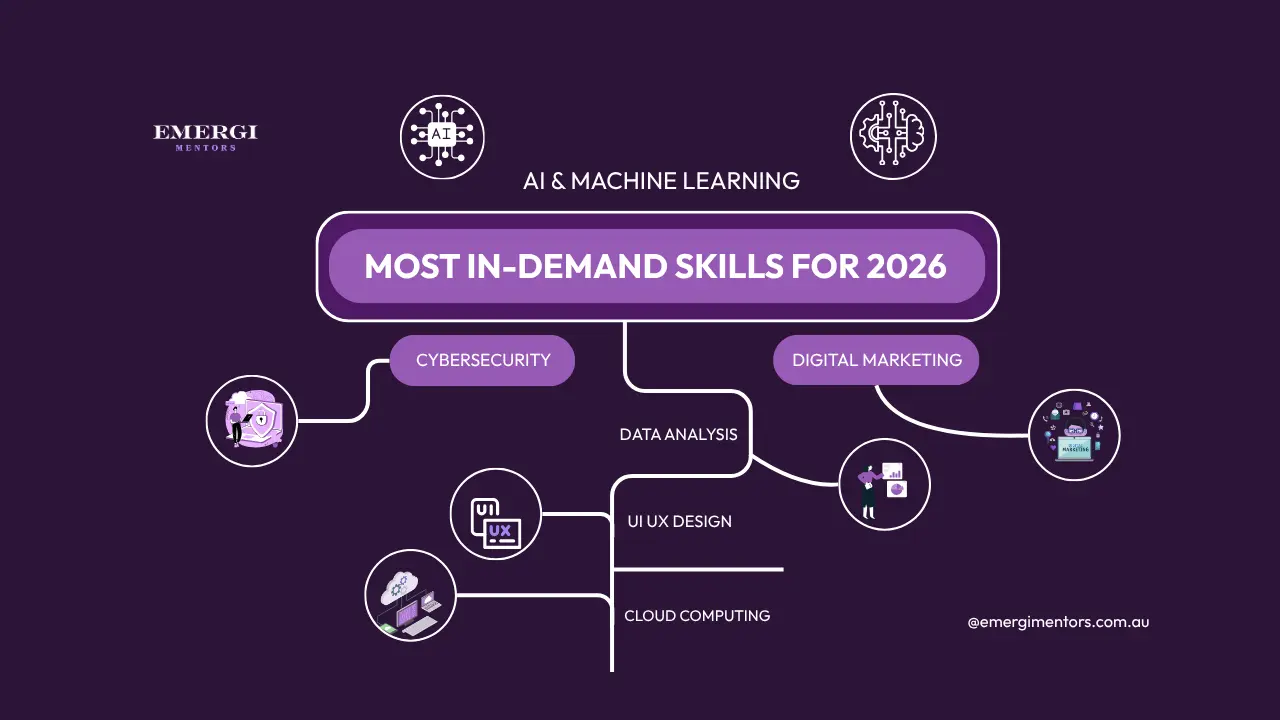
Data and analytics tools. SQL remains the single most requested technical skill in data-adjacent roles, followed closely by Python for analysis and automation. Power BI and Tableau dominate the visualisation side, with Power BI holding a clear edge in Australian corporate environments because of its tight integration with Microsoft's existing enterprise stack.
Cloud platforms. AWS and Azure certifications are increasingly treated as a baseline rather than a bonus, particularly for engineering-adjacent analyst roles where data pipelines live in the cloud rather than on local servers.
AI and automation literacy. Employers aren't necessarily asking candidates to build machine learning models from scratch. More often, they want people who can use AI tools competently inside a workflow, and who understand enough about how models work to sense-check outputs rather than accept them blindly.
If you want the fuller occupation-by-occupation picture, including which roles are projected to grow fastest through the next decade, our breakdown of high demand tech jobs in Australia over the next 10 years goes deeper into the numbers behind each career path.
Want to build both the technical and transferable side at once?
Emergi Mentors' 6-month program pairs live technical training with 15+ portfolio projects, PL-300 certification prep and a guaranteed 12-week Australian internship, so the transferable skills above get practised in a real work environment, not just talked about.
How to Prove You Have These Skills, Not Just List Them
Most job seekers lose credibility by just listing skills and not proving them with results. Listing "strong communicator" and "proficient in SQL" on a resume costs an employer nothing to ignore, because every candidate's resume says the same thing. What actually moves a hiring decision is proof.
For technical skills, that means a portfolio: real projects with real datasets, ideally tied to a business problem rather than a tutorial dataset everyone recognises. A recruiter who sees a Power BI dashboard built around Australian retail or healthcare data learns more in thirty seconds than they would from a bullet point.
For transferable skills, proof looks different but matters just as much. A specific story about a time you adapted to a last-minute scope change, told in a structured way during an interview, does more work than the word "adaptable" ever will. Certifications, internships and documented team projects all function the same way: they turn a claim into evidence.
This is the core idea behind what we call proof-over-skills at Emergi Mentors. Skills acquisition on its own gets you halfway. Employer-ready proof, in the form of a portfolio, a certification, and real workplace experience, is what closes the gap the other half of the way.
Building a Skill Set That Actually Gets You Hired
Self-directed learning can absolutely get you the technical fundamentals. Where most people stall is turning that learning into something an employer trusts enough to act on. That gap is exactly what structured mentorship is built to close: a mentor who has sat on the other side of the hiring table can tell you which of your projects would actually impress a panel and which ones read as generic tutorial work, long before you find out the hard way in an interview.
Emergi Mentors' Full Stack Data Analytics and Data Engineering Program was built around that gap. It combines live technical training, 15+ portfolio projects built on real business scenarios, PL-300 certification preparation, and a guaranteed 12-week Australian internship so the transferable skills above (communication, collaboration, problem-solving) get exercised in an actual workplace, not just described on a resume.
The Bottom Line
Skills in demand in Australia right now sit at the intersection of technical capability and human adaptability. Neither one carries a career on its own. A data analyst with flawless SQL but no ability to explain findings to a non-technical stakeholder stall at the same point as a brilliant communicator who's never touched a real dataset.
If you want clear, personalised guidance on where your current skill set stands against what employers are hiring for, connect with a mentor and we'll map it out together.
Frequently Asked Questions
What are the top 10 transferable skills?
The top ten transferable skills are communication, problem-solving, adaptability, collaboration, critical thinking, time management, attention to detail, leadership, digital literacy, and emotional intelligence. These work across industries because they describe how someone works, not which software they've used.
What are the top 5 skills in demand right now?
SQL and data analysis, AI and automation literacy, cloud computing (AWS or Azure), cybersecurity fundamentals, and adaptability.
What are the 7 transferable skills?
Communication, problem-solving, adaptability, teamwork, time management, leadership and digital literacy are transferable skills that appear in most Australian jobs.
What is the highest demand skill right now?
On the technical side, AI and data literacy currently are the top most in demand skills in Australia. In soft skills, adaptability is frequently ranked highest, since it's the skill that lets someone absorb new tools and shifting priorities without a drop in output.